.
.
Previous: Part 1 of the Blake story
The Blake Story, Part 2
Charles Blake
soldier and emigrant, generation 4
Due largely to his Army service, we know a great deal more about Charles Blake than about most ancestors. But first a recap of Charles's ancestry.
Brief Summary of Part 1
There were many Blake Families in 18th and 19th century England, and for centuries before that, including a number of Blake families in South Kent during the 18th century. This story focuses on a Blake family from Canterbury, Kent, England. The ancestors of Barbara, Julie and John Blake of Brisbane. It sits in this 'BFBI' site since Barbara married me in 2017.
Generation 1
George Blake and his wife Elizabeth had 8 children baptised in Canterbury between 1793 and 1803. Which makes it likely, but not of course certain, that George and Elizabeth married around 1790 and were born around 1765.
Generation 2
William, the son of George and Elizabeth, was baptised at St Dunstan's church, Canterbury on 8 July 1798.
{The weakest link in the chain of this family history is at this point. We cannot definitively say that the William born to George and Elizabeth is the same man as the William who is recorded as the father of William the younger}
The baptism record for son William ("the younger") shows the wife of William the elder to be Elizabeth. The marriage certificate of William the younger in 1855 says William the elder is a wire worker.
Generation 3
William Blake, the younger, was baptised at St Alphage in Canterbury on 28 November 1830, the son of William and Elizabeth. William the younger then appears in the 1851 census at Woodstock in Oxfordshire married to Emma Blake with one son Henry, aged 1 month. He is a wire worker.
In 1853 William and Emma are living at Waterside in Chesham when son William ("the third") is born on 5th February. His birth certificate gives his mother's name as Emma Blake formerly Platt (or just possibly Plant or Plath). William is again described as a wireworker. At Aylesbury in 1855 he marries Emma Trump.
On 10 April 1865 Charles, the great-grandfather of Julie, Barbara and John is born at Waterside in Chesham. By 1867 William & Emma and their family, Charles and his siblings, have moved to Sunbury in Middlesex.
William dies in 1889.
Generation 4
Charles Blake 1865-1953
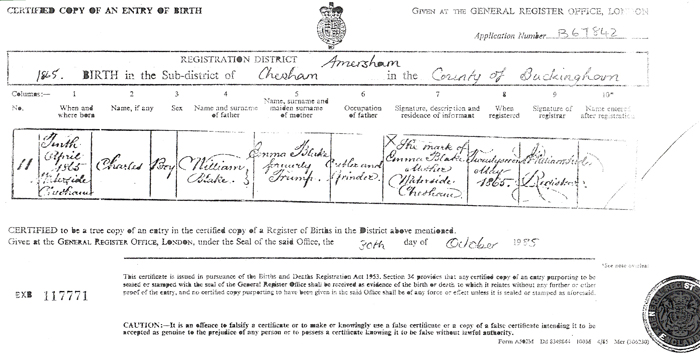
Charles Blake, the emigrant to Australia, was born in the Waterside district of Chesham in Buckinghamshire on 10 April 1865 and within two years moved, with his parents, to Sunbury-on-Thames in Middlesex, sometime before the birth of his sister Emma there in 1867. The stories of Charles's brothers and sisters are in Part 3.

He was certainly there by 1871 and was still at home with his parents in Sunbury, age 16, at the time of the 1881 census ( not aged 18 as the census shows !). In that census he, and his father, both appear to give their occupation as Gas Fitter.

In 1885, on the 9th May, Charles swore the oath, apparently in London, to enlist as a private soldier, number 2958, in the 2nd Dragoon Guards "The Queen's Bays". The available Army records for Charles are shown in full in a separate page.
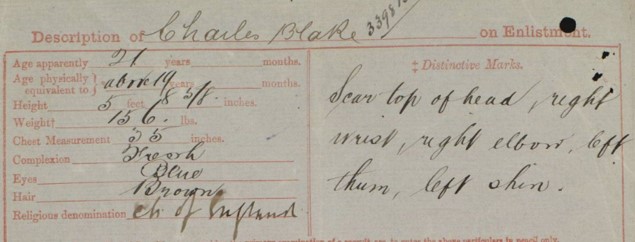
He joins his regiment, at Aldershot in Hampshire, on 12th May. He is age 20, and says on enlistment that he is a blacksmith. He also declares that he had previously served in the Volunteers - 8 Middlesex. This reference would seem to be to the 8th Middlesex (South West Middlesex) Rifle Volunteer Corps(1) (which at some point became a volunteer battalion of the Middlesex Regiment). Which might explain why his age had been inflated at the time of the 1881 census.

His medical examination in London on 9th May, confirming him as fit for service in the Army, shows his physical particulars:
Shortly before Charles joined up, the 2nd Dragoon Guards had returned to Aldershot from active service in Sudan and Egypt. On the 3rd August 1885 they were inspected by Major General Sir D.L. Drury Lowe K.C.B. The following observations were made and communicated to the Regiment by letter dated H.G.W.O. 23.10.85.

"This fine Regiment has much improved of late as H.R.H. himself observed and may be considered in a generally very satisfactory condition."
The illustrations show, on the left, the full dress uniform of a private in the 2nd Dragoon Guards at this time and, on the right, the field-day order - exercises in full dress but without helmet plumes.
There would also have been an undress uniform and other orders of dress, such as stable dress. If you are interested you might take a look at the comprehensive uniformology site
 The Band of the 2nd Dragoon Guards in 1896. Charles actually left the regiment some years earlier but the general appearance would have been similar in 1885 and the lithograph (2) seemed too nice a find to leave out. Note that although the musicians have white helmet plumes, the regular soldiers behind them have black
A few days later in August the Regiment marched from Aldershot to Shorncliffe Barracks near Folkestone in Kent, a trip of some 97 miles. Depending on which troop Charles was in, they left either on 6th or 7th August and arrived at Shorncliffe on 11th or 12th August 1885. A troop in the cavalry was the operational unit, in the same way as a company was in the infantry. In line with standard practice the 2nd Dragoon Guards had 8 troops identified as A to H. They were [may have been] paired into squadrons.
 This print of Shorncliffe camp dates from the 1850s. The lines of huts had been laid out in 1854/5 at the time of the Crimean War. The uniforms had changed by 1885 but the huts were still there although an extensive programme of building brick barracks had begun.
Under the command of Lt Colonel Hemming Lee, the 2nd Dragoon Guards left England in the Troop Ship 'SERAPIS' on 21st November 1885, and reached Umballa on 3rd January 1886. Before leaving, the horses of the 2nd Dragoon Guards were handed over to the 9th Lancers on the 17th November 1885.
HMS Serapis was an iron screw Euphrates-class troopship in service from 1866 to 1894.
Presumably the regiment disembarked at Bombay and went from there to Umballa, now written as Ambala, which is in the north of India, near to the foothills of the Himalayas. Travel from Bombay to Delhi by train would, according to the railway map, left, have been possible but the last 125 miles up to Umballa may have been a march. {Ambala is later on the rail network but at 1886?} Charles and his fellow soldiers will have been glad it was not the hottest time of the year.
On 17th January 1887 Private Charles Blake is promoted to Lance Corporal and on 9 May 1887, after 2 years service, is granted Good Conduct pay. A month later, on 10 June 1887 he is put on the "Unattached list" and transferred to the Naini Tal Depot. Nainital is a hill station …………. Although the map on page x makes the two locations look close together this was a journey of about 250 miles. Train? The unattached list………….
On his transfer to Naini Tal he is shown as an Armourer. There is some ambiguity in his Army Record at this point. He is also shown as having passed the Instructions for Armoury Sergeant (India) Second Class, apparently at 16th April 1887 [picture] 21 March 1889 entry may signify his returning from the unattached list to his regiment. Or it may simply be recording his status at the start of a new page in his record.
On 21 March 1889 Charles Blake is promoted from the rank of probationary Armoury Sergeant to Sergeant 2nd Class and transferred in his new rank from the 2nd Dragoon Guards to the Corps of Armourers . Upon changing units his service number also changed, to 676. At the same time his conditions of service are altered to "18 years with the colours" which involved him signing up to an additional x years from his original engagement for years.
On the same day, he is immediately "posted for duty" to the 'I O Dept' - which must surely be the Indian Ordnance department. 'Posted to' signifies that he remains part of the Corps of Armourers but is stationed at another unit, commonly referred to as being "attached" to that unit. Given what we shall see a little later of his personal life, it seems highly likely that his service with the IOD was at the Ordnance factory and Gunpowder works at Kirkee; quite probably serving under, or certainly alongside, Conductor John Garner of the Ordnance Department, which was a part of the Army.
Thirteen months later, on 24 April 1890, he is posted for duty to the 1st Battalion of the Worcestershire Regiment. The 1st Battalion of the Worcestershire regiment had been in India since 1879 (when it had still been the 29th Foot ) but in March 1890 it moved to Poona and remained there until sometime in 1893. As an infantry regiment they would have been at barracks in the 'main' Poona cantonment to the east of the city, as blue-circled on the map.
"The major military lines [for the European Infantry Regiments] were located at Ghorepuri and Wanowri and were respectively to the north east and south east of the Cantonment. These two complexes housed the European regiments serving in Poona"
"The Cantonment was regarded as possessing a fine road system, particularly in comparison with the 'Native City'. Cantonment roads were wide and tree lined, and since most were not sealed until the twentieth century the roads were watered twice daily in the hot season to minimise the dust. Roads were also provided with surface drains that were flushed twice daily to remove horse sullage."
The function of the Sadr Bazar was the provision of goods and services to the European community of Poona. Of course the 'Native City' had its own market areas, but the British preferred not to enter the environs of the old city, and the Sadr Bazar provided a 'safe' compromise whereby British consumption and contact with Indian merchants was concentrated in an enclave external to the British culture area and yet ostensibly under British control. In this way the colonial community did not have to enter the Native City and nor were Indian merchants required to live in proximity to the British. Since the function of this enclave was to service the expatriate British population, it was in the Sadr Bazar that the 'Europe Shops' were located; establishments that sold goods imported from Britain (ranging from tins of food to toiletries) that were prized by the British community usually for the sole reason that they were from the metropolitan society.
While serving in India Charles Blake got married at All Saints Church, Kirkee (on the outskirts of Poona) to Kate Garner on 3 April 1893 (Source: Church register). The original marriage certificate is held by JD. They are, the same day "Placed on [the] Married Establishment". All Saints was the garrison church at Kirkee and was where Kate had been baptised. It was, and remains, a little piece of England marooned in central India. [more photos?] There is a photo (held by JD) of the wedding party on the church steps.
"Although adjacent to Poona, Kirkee was an autonomous settlement run by a separate Cantonment Committee and hence these military lines provided all the services usual to a cantonment including a church, burial ground, bazar, a hospital and a lock hospital ."
Kate had been born in Kirkee on 4th December 1872, the daughter of Edward Garner and Charlotte (nee Piper) and was baptised at All Saints on 17th January 1873. Probably in the font pictured right.
Edward Garner worked, as a civilian, at the Ordnance department gunpowder works (shown red-circled on the 1911 map on the previous page as the Arsenal and Small Arms Ammunition factory). It seems safe to assume that Charles and Kate met after Charles had been posted to the Indian Ordnance department in 1889 or (if his IOD posting was not at Kirkee) after he was attached as an Armoury sergeant to the Worcestershire Regiment in April 1890. Though it is just possible they had met earlier in England. Kate's family home at Hawridge is very close to Chesham where Charles was born. To engage in a moment of speculation it seems highly likely that Edward Garner was a guest at the Sergeants' mess from time to time, which Armoury Sergeant Charles Blake would have been a member of while attached to the IOD. There is more about the Garner family in Part 3 of this History.
At the time of their marriage Charles's location, as shown in the church register, was Kamptee, which is on the outskirts of Nagpur in the very centre of India. The 1st Battalion of the Worcestershire Regiment, had moved there from Poona some time in 1893.
In 1894, while at Kamptee, Charles and Kate have their first child, Charles William. He dies however within 3 months, of measles. The same register shows another death of a child of a sergeant of the regiment from the same cause a few days earlier.
On 21 March 1894 Charles is promoted to Armoury Sergeant 1st class. He remains attached to the 1st Worcester infantry regiment. At 21 July 1894 the 1st Worcester are listed as still being stationed in Kamptee .
According to [ ???? ] the Corps of Armourers became incorporated in 1894 within the Army Ordnance Corps (AOC). However, Charles's own service record first shows his transfer to the Armourer section of the Ordnance Store Corps on 1st April 1895 and his service as being 'continued' with the Armourer section of the Army Ordnance Corps from 1st April 1896, still as soldier number 676.
Later in 1894 the 1st battalion of the Worcestershire regiment is moved from Kamptee to Rangoon in Burma, which the British Army at that time regards as being part of India.
[Story from regtl diary@ "Colonel Peacocke was born near Dublin, Ireland in 1865. He first commissioned into the 5th Dragoon Guards in August 1884, but after a short time he transferred to The Worcestershire Regiment. He was seconded for service with the Army Service Corps, rejoining the Regiment in 1887. On home service with the 2nd Battalion at Pembroke Dock until posted to the 1st Battalion in India. He served with that Battalion at Poona, Kamptee, Rangoon and Aden, coming home with them to Tregantle Fort, Devonport, in 1896." ??is this the extract from the reg diary or another quote?
We know Charles and Kate went with the Worcesters for their second son, Denis Patrick, was born in Rangoon at 9 December 1895. However the Regiment had moved from Burma to Aden at the end of November 1895. Although the regiment had left for Aden, Kate at least stayed on in Rangoon to give birth to Dennis. At the time the regiment moved she was around eight and a half months pregnant. We do not (yet) know if Charles was allowed to stay with Kate or whether Kate stayed by herself. Or when she (and he?) were able to rejoin the regiment. The regiment was only in Aden for a short time before returning to England, to Tregantle Fort at Devonport, in 1896. His "Home service" is noted as restarting on 13 November 1896.
While at Devenport he is re-engaged on 27th April 1897 for the Armourer section of the AOC and his service is further extended to 21 years from his original enlistment. Also while at Devenport Charles and Kate have their third child and first daughter Nora Beatrice born on 22 October 1897 .
At some time in 1898/99 the Worcesters then moved to another barracks at Crown Hill in nearby Plymouth .
While serving at Crown Hill their third son, Charles ("the younger") is born on 22 November 1898 at Crown Hill Barracks. Charles junior will become the grandfather of Julie, Barbara and John. JD has a copy of the birth certificate. It confirms his occupation as Armourer sergent 1st Worcestershire regiment. The birth was registered on 3 January 1899 - which expalins the difference between GRO index and birth years.
As an Armourer in the Corps of Armourers, Charles was not fully part of the Regiment but was only'attached' to them. From 1881, when major army reform and restructuring occurred, the Corps of Armourers had been "placed under OSC administrative control" but it was still a separate unit.
Other ranks life pages 173ff the nafziger file for 4 July 1896 makes this look odd - the battalion had left well before December 1896.Same info at http://www.britisharmedforces.org/i_regiments/worcs_index.htmOn the 23rd March 1899 his attachment to the Worcestershire regiment, which had lasted just under 9 years, ends and he is posted to the Army Ordnance Corps at Aldershot. Having moved to Aldershot Kate and Charles have another daughter, Florence Ellen, born on the 9th of February 1900.
This beautifully clear photo [ a complete photo or an extract from a larger image?] of Charles in his pillbox cap shows him with the Ordnance Arms as his collar badges. Which certainly dates the picture to post 1896 when the Corps of Armourers was absorbed into the Army Ordnance Corps ( it did not become the Royal AOC until 1918 ) and may date it to after his posting to the AOC at Aldershot in 1899.
There is a handed-down family story of Charles having been a pall bearer at Queen Victoria's funeral on Saturday, 2 February. For reasons set out in a separate article this appears not to have been the case.
Shortly after the death of Victoria, on 18th February 1901 Charles moves to the "Depot" AOC (the depot company at Woolwich?) to await embarkation to South Africa. By this time the Second Boer War has already been underway for 16 months since 11 October 1899. At 5th March he is posted to the AOC at Cape Town for duty. The entry does not make clear whether this is when he leaves England or arrives in South Africa. His 'home' service is shown as ending on 4 March 1901 and his SA service to begin the following day. At 4th April he is posted to the 2nd battalion of the Worcestershire Regiment - the same regiment as before but a different battallion which had already been out in South Africa for 15 months.
At the outbreak of the Boer War both the 1st and 2nd Battalions were mobilised and sailed to South Africa. The 2nd Battalion (including a company of men from the Worcestershire Volunteer Battalions) was the first to arrive and landed at Cape Town on the 10th January 1900, and as a result saw more action and had more casualties. There is a great deal of information about the battalion's service in a diary maintained by a Capt Wodehouse - a name we will return to later.
At April 1901, when Charles joins them, the 2nd battalion of the Worcestershire Regiment seem to be at Buffelspoort, about 60km West of Pretoria.
"From January until May the [12th Infantry]Brigade was continually on treks, garrison and convoy duties and seeing action on an almost daily basis. …[more] …….
At the 1901 census, while Charles was away on active service, Kate and their children Dennis (pictured), Norah, Charles junior and Florence were living at 4 Glebelands Gardens in Shepperton, Middlesex. Shepperton and Sunbury on Thames (where Charles's mother and some of his siblings still lived) are right next to each other. Kate was already pregnant when Charles left to go to war and gave birth on 11 (or 17) June 1901 to Arthur Frederick who died aged less than a year in 1902 (registration 1902 Q2) while Charles was still away. On 4 (or 9) May 1902 according to Charles's army record.
In the Blake family archives there is a set of photographs marked as being from the Boer war or South Africa. These do not relate directly to Charles's service and can be seen in a separate article. This just one of them:
 TEXT
TEXT
But, as discussed above it is unclear whether he would have worn this uniform with an additional badge above his sergeant's stripes or whether he would have worn AOC uniform. The picture on the right is actually an AOC private from 1910 , rather than a sergeant, but the key point is that it was blue with red facings. Charles in his pillbox photo certainly does not have a white collar.
The Medal Rolls for the Armourer section of the Army Ordnance Corps show C.Blake, Armourer Sergeant 1st class, regimental number 676 as being eligible for the [Kings] South Africa medal and clasps, initially for Cape Colony with Transvaal and Orange Free State added later. A second roll shows his eligibility for the 1901 and 1902 date clasps. In both cases he is shown as serving with the 2nd Battalion of the Worcestershire Regiment. There is a corresponding entry in the Worcestershire regiment records confirming his date of 'transfer' from the AOC. His discharge record shows him as being entitled to ……..
At some point in his service Charles, with the Worcesters, serves at Heilbron SRC. This is mentioned in a testimonial by the Lt Colonel of the regiment endorsed on a picture of a Maxim machine gun mounted on a tripod, apparently designed and built by Charles. The picture is a bit damaged and has been mounted on what appears to be an old photo mount from a Weybridge studio. The handwritten testimonial, also a bit damaged, is strangely written around two sides of the picture. Whether it is the original writing or a later transcription is not clear.
I saw this excellent Maxim Gun mounting daily during its construction [??? ] {?India ] by Arm Sgt Blake at Heilbron SRC. It was a beautiful [ ] of [ ]manship in spite of the want of tools, appliances and materials, which [……] for the purpose. The legs were [ ] from the [?suction?] pipe of a pump, the plate was [?cut?] from [?boiler plate?] and the T arm for the Maxim [……] square [ ]. When finished it provided an ideal [?secure?] mounting to fire the gun from. H de B Hovell Lt Colonel 2 Worc
It is 'signed' by Lieut.-Colonel Hugh de Berdt HOVELL, D.S.O. commanded the 2nd Battalion Worcestershire Regiment from July 1908 to March 1913. While in South Africa he had the ranks of Captain and Major. Which indicates that this testimonial was written after Charles Blake's service had finished. Or that it was a later transcription with the later rank added. The card on which the image is pasted and on which the testimonial was written appears to have been a photo mount from a photographers in Weybridge which is consistent with it having been done in or after 1908
Sgt. Charles Blake returned from South Africa in June 1903. He returned to England apparently as an individual; the 2nd battalion would not leave until October 1904, when they posted to Combo in Ceylon rather than returning home to England.
-Charles rejoined the Depot Company of the AOC on 23 June 1903 and almost immediately, at his own request, was discharged from the army at Woolwich on 10 July 1903, having completed 18 years and 63 days service. He left with a pension of 22? Pence per diem for life plus the "South African Gratuity of twelve pounds and 10 shillings". However in a note on his discharge papers he states "I have received £5 only of monies due to me". Reaching 18 years service in May seems to have given him the right to request a discharge.
His intended place of residence is given as Osman Villas, Nursery Road, Sunbury-on-Thames, which is a road leading off Green Street where his parents had lived. His trade is stated to be 'blacksmith and gunsmith'.
The text included in the Australian Boer War Memorial website about Charles's character sounds as if it comes from discharge papers
JD has discharge papers.


.jpg) This family photo appears to date from June/July 1903, shortly before Charles left the Army. At this date Denis was 7, Nora was 5, Charles was 4 and Florence was 3. Matching these to the pictured children; Denis looks older than 7 and the seated girl - Nora -looks older than 5. Charles is a good deal shorter and looks younger than his younger sister Florence.
This family photo appears to date from June/July 1903, shortly before Charles left the Army. At this date Denis was 7, Nora was 5, Charles was 4 and Florence was 3. Matching these to the pictured children; Denis looks older than 7 and the seated girl - Nora -looks older than 5. Charles is a good deal shorter and looks younger than his younger sister Florence.
Two further daughters were born in England, Lillian May in 1904 (registered Q2 Staines, baptised at St Mary Sunbury 29 May) and Katie Evelyn in 1906 ( registered , baptised St Mary Sunbury 2 Sept). In the 1904 baptism record Charles is still identifying himself as an Armourer. At 1906 Charles was described as a 'Smith and fitter'.
On the same day as Lillian May was baptised, so was Margaret Rose BLAKE, the daughter of Henry and Lucy. Henry was a tinsmith. The 1901 census shows him to have been born in Witney in Oxfordshire - Charles's eldest brother. He was living and working on his own account from Pomfret House in Green Street. In the 1911 census entry for Henry and Lucy, Margaret Rose BLAKE appears as Maggie.
This photo is believed to be of a shop in the UK and the boy to be Dennis Patrick, who was 12 when they moved to Australia.The family moved to Australia in 1908. They travelled on the SS Omrah which arrived at Brisbane on 31st July 1908. The entries listed in ??record ?? show only the men in the family, Charles, Dennis and Charles Jnr. Charles is described as a farmer and as having a wife and 6 children. The occupation is surprising but is repeated when his son Charles marries in 1921. Charles senior's occupation is given as grazier. Obituary reports refer to him having set up a blacksmith business later in life - in the early 1930s
 The SS Omrah, an ocean liner for the Orient Steam Navigation Company built in 1899 for passenger service between the United Kingdom and Australia
More material on Omrah:
http://www.musgroves.co.uk/1911%20langman%20and%20wornham%20to%20australia.html
http://www.simplonpc.co.uk/Orient1.html
The SS Omrah, an ocean liner for the Orient Steam Navigation Company built in 1899 for passenger service between the United Kingdom and Australia
More material on Omrah:
http://www.musgroves.co.uk/1911%20langman%20and%20wornham%20to%20australia.html
http://www.simplonpc.co.uk/Orient1.html
According to the death certificates of Kate and Charles in 1949 and 1953 their youngest daughter was Charlotte Rose whose given age puts her birth date as 1912. I have not been able to find any record of this birth but a number of Ancestry trees identify her as born 12 May 1912 at Brigalow in Queensland - the source for this is a death of Charlotte Rose Seidman in Darwin though there is .
(1) back to text I can find very little on this volunteer unit, except that it was one of hundreds of volunteer corps, of which the majority were rifle corps: http://www.territorioscuola.com/enhancedwiki/en.php?title=Volunteer_Force_(Great_Britain) Their uniform is reported as grey with grey facings. According to uniformology.com "Despite being a recent ally of France in the Crimean War of 1854-5, it was fear of invasion by that nation which encouraged the establishment of a volunteer force. The French victory over Austria in 1859 caused further alarm and even though the raising of Volunteer units had been under way for a couple of years, its pace was accelerated and thousands of Rifle Corps were raised all over England, Scotland and Wales. Organizing these enthusiastic but amateur soldiers presented a headache for the War Office but a system using the Lord Lieutenancies of the various counties under an old act of 1804 finally brought some order. Through various reforms during the next twenty years these Volunteer Rifle Corps were combined into companies, battalions and auxiliary units attached to the regular army."
(1) back to text Lithograph by Richard Simkin, dated 1896, 24cm x 192 - an original antique print being offered in 2014 for just £45.